


IP cameras have become the standard for industrial monitoring and documentation. In B2B and industrial environments, it is not only about “video surveillance” — it is about reliability, traceability, and safety in production environments, logistics, and energy.
In this guide, we cover:
- what an industrial IP camera is
- which technical parameters to focus on
- the difference between dome, bullet, and ATEX dome
- practical examples of IP cameras for typical scenarios
What is an IP camera, and why use it in industry?
An IP camera is a network camera that transmits video digitally via Ethernet. This makes it easy to:
- integrate cameras into existing IT and OT networks
- use PoE for both power and data
- connect cameras directly to an NVR, VMS, industrial PC, or SCADA solutions
- enable remote access, alarms, and analytics (e.g., AI-based detection)
In industry, IP cameras are typically used for:
- monitoring production and machine lines
- access control and monitoring of gates, ramps, and fences
- security in critical infrastructure
- documentation in ATEX zones and corrosive environments
Resolution and image quality: 4MP vs 5MP
Resolution determines how many details you can see in the image.
- 4MP (2688×1512) is a solid starting point for general surveillance where you need to see people, vehicles, and overall movement.
- 5MP (2880×1620) provides extra detail, relevant for process monitoring, documentation, or when one camera must cover a larger area.
A good example of a high-resolution industrial IP camera is:
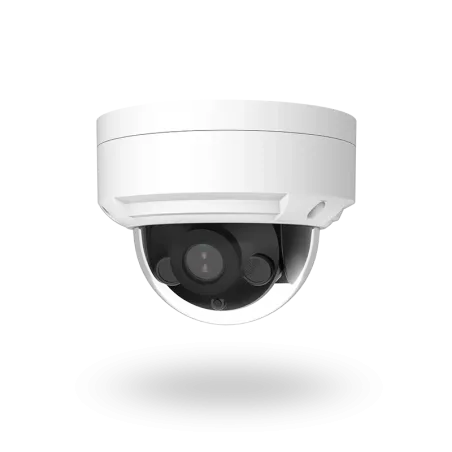
For many classic surveillance tasks in warehouses, outdoor areas, and around buildings, 4–5MP is often a great fit — especially at 25/30 fps.
Lens selection: fixed vs motorized zoom
Fixed lens
A fixed lens provides a fixed field of view. A 2.8 mm lens offers a wide angle that works well for:
- general area surveillance
- monitoring entrances, corridors, and smaller spaces
Motorized zoom
A motorized zoom lens lets you zoom in/out via software or an NVR — ideal when:
- the camera covers gates, driveways, or long stretches
- you need to zoom in on license plates, trucks, or specific zones
- the distance to the subject can change
A good example is:
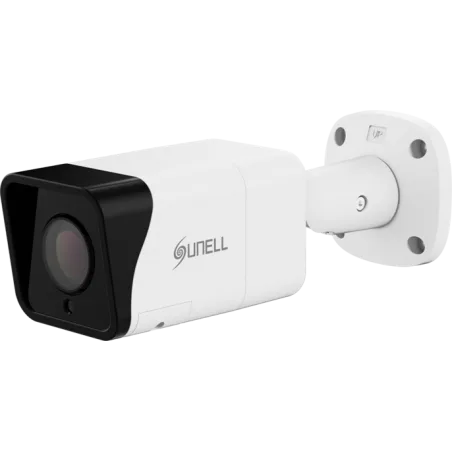
Motorized zoom cameras provide flexibility, especially when the installation is not fully defined in advance or when one camera must cover multiple scenarios.
Dome vs bullet: when to use what?
Dome cameras
- More compact and discreet
- Great for facades, entrances, ceilings, and general indoor/outdoor surveillance
- Often better protected against vandalism (IK10)
Bullet cameras
- Highly visible and “signals” surveillance
- Easier to aim at specific areas (gates, fences, driveways)
- Often longer IR range and room for larger optics
For entrances, warehouses, and facades, many choose a combination:
- Dome cameras close to the building
- Bullet cameras facing roads, gates, and fences
IR illumination and night performance
Industrial environments often have poor lighting — for example outdoors, in warehouses, or in process areas. That is why IR illumination and image processing are crucial.
- IR up to 30 m is suitable for yards, smaller areas, and typical industrial facades
- IR up to 40 m is ideal for long driveways, ramps, and large outdoor areas
- Features such as 3D DNR, DWDR, and smart IR deliver sharper images in low light
If you need reliable identification in the dark, the combination of high resolution, strong IR range, and noise reduction is often more important than daytime image quality.
Ruggedness: IP rating, IK rating, and materials
In industrial environments, cameras may be exposed to:
- rain, dust, snow, and moisture
- impacts, vibration, and accidental contact
- chemicals and corrosion
Therefore, look for:
- IP67/IP68 – dust- and waterproof for outdoor and demanding environments
- IK10 – impact resistant for vandal-prone areas and harsh handling
- Metal or steel housing – better resistance to impacts and environmental exposure
ATEX dome camera for explosive environments
In environments with explosive gases, dust, or corrosive liquids, there are strict requirements for equipment. You cannot use a standard dome or bullet camera.
You need an ATEX-certified IP camera approved for the relevant zones and gas/dust classifications.
A concrete example is:
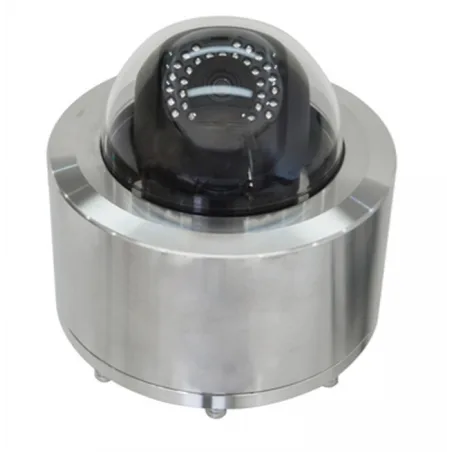
Key characteristics of this ATEX dome camera:
- ATEX Zone 1 & 2 classification
- Stainless steel SS304 (option SS316L with minimum 5 pcs)
- Explosion-proof and corrosion-resistant dome design
- IP68 full protection against water and dust
- Suitable for areas with explosive gases, dust, and corrosive liquids
If you work in chemical industry, oil & gas, food production with strong cleaning agents, or similar, this kind of ATEX dome camera is often a requirement, not an optional add-on.
Smart features: detection and analytics
Modern IP cameras often include built-in video analytics (VCA):
- Detection of faces, people, and vehicles
- ROI (Region of Interest) – focus on specific areas in the image
- Masking – mask private areas in the image
These features are useful if you want to:
- reduce false alarms
- improve event logging
- integrate video data into other systems (access control, logistics, QA)
PoE, power consumption, and integration
For industrial installations, PoE is almost always preferred:
- one cable for both power and data
- easier installation
- centralized power management and UPS backup
Many devices also support industrial standards such as ONVIF, SDK, and CGI, making them easy to integrate into most NVR/VMS solutions as well as custom software on industrial PCs.
Which IP camera should you choose?
1. Standard outdoor surveillance
Choose, for example, a 5MP outdoor dome IP camera:
- Rugged dome (IP67, IK10)
- 5MP resolution
- IR up to 30 m
- Ideal for buildings, entrances, and yard areas
2. Long distances, driveways, and flexible scenarios
Choose, for example, a 4MP bullet IP camera with motorized zoom:
- Bullet form factor, visible surveillance
- Motorized zoom 2.7–13.5 mm
- IR up to 40 m
- Suitable for gates, long fences, and parking areas
3. Explosive atmosphere and corrosive environments
Choose, for example, a 5MP ATEX dome camera in stainless steel:
- ATEX Zone 1 & 2
- Stainless steel housing, IP68
- Designed for gas, dust, and corrosive environments
Frequently asked questions about IP cameras (FAQ)
Are IP cameras better than analog cameras in industrial environments?
Yes. IP cameras deliver higher resolution, easier PoE integration, better analytics, and simpler integration with other systems.
Can I mix different IP cameras on the same network?
Yes, as long as the network is sized correctly and the cameras follow standards such as ONVIF. You can combine dome cameras such as KAM-U-DOM5MP and KAM-EX-DOME5MP with bullet cameras such as KAM-U-BOX4MP-Z.
When is an ATEX camera required?
When the area is classified as hazardous (Zone 1/2), or when required by authorities or customer safety procedures. In those cases, choose an ATEX dome camera such as KAM-EX-DOME5MP.
Conclusion
Industrial IP cameras are not one-size-fits-all. Environment, ruggedness requirements, resolution, zoom, and certifications determine what you should choose:
- Dome cameras for compact, rugged, and often discreet surveillance
- Bullet cameras for visible surveillance and longer distances
- ATEX dome cameras for explosive and corrosive environments