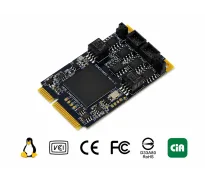
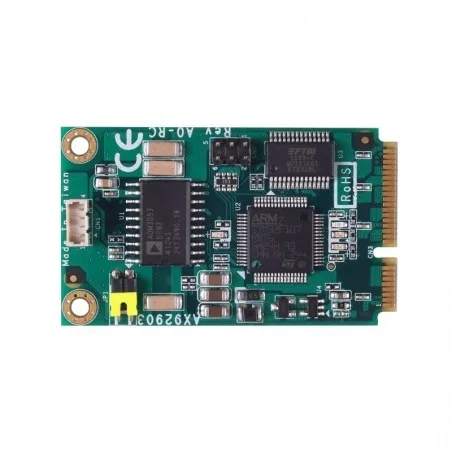
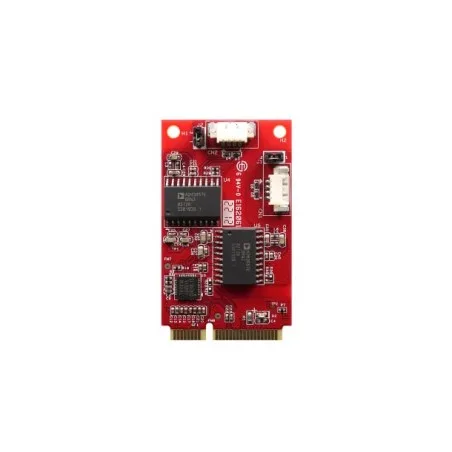
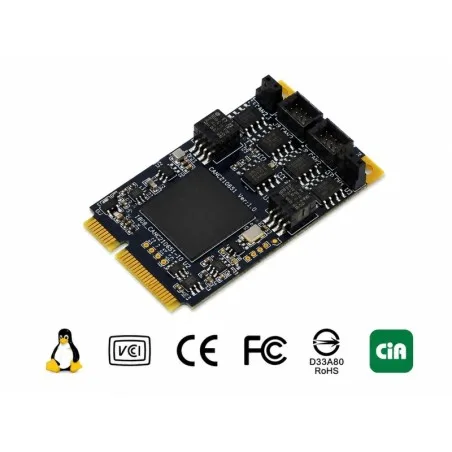
Industrial CAN Bus Cards in Mini PCIe (mPCIe) Format
Reliable communication is critical in modern industrial and embedded systems. With a professional CAN Bus card in Mini PCIe (mPCIe) format, businesses can integrate stable and high-speed CAN communication directly into industrial computers, vehicle PCs, embedded systems, automation platforms, and edge computing solutions.
At DANBIT, we supply industrial-grade mPCIe CAN Bus cards designed for demanding B2B environments where long-term reliability, compatibility, and robust operation are essential.
What is CAN Bus?
Controller Area Network is one of the most widely used industrial communication protocols for real-time data exchange. Originally developed for automotive systems, CAN Bus is now heavily used across industrial automation, transportation, robotics, marine, and embedded applications.
CAN Bus enables multiple devices to communicate over the same network without requiring a central host computer, making it ideal for distributed industrial systems.
Common CAN Bus Applications
-
Industrial automation
-
Embedded Linux systems
-
Vehicle and transportation systems
-
Marine and offshore installations
-
Robotics and motion control
-
Energy management systems
-
Medical equipment
-
Smart manufacturing and Industry 4.0
Why Choose a Mini PCIe CAN Bus Card?
A Mini PCIe (mPCIe) CAN Bus card offers a compact and highly reliable solution for adding CAN connectivity directly into industrial and embedded hardware platforms.
mPCIe CAN cards are commonly integrated into:
-
Embedded PCs
-
Industrial Box PCs
-
Panel PCs
-
Vehicle computers
-
Edge AI systems
-
Rugged mobile systems
-
Industrial gateways
Advantages of mPCIe CAN Bus Interfaces
-
Compact industrial design
-
Low power consumption
-
High vibration resistance
-
Reliable operation in harsh environments
-
Direct PCIe communication for low latency
-
Easy integration into existing systems
-
Multi-port CAN support
-
Long product lifecycle availability
The compact form factor makes mPCIe ideal for space-constrained industrial applications while maintaining high communication performance.
Opto-Isolation – Essential Protection in Industrial Environments
Industrial systems often experience electrical noise, voltage spikes, ground loops, and electromagnetic interference. This is why opto-isolated CAN Bus cards are highly recommended in professional installations.
What is Opto-Isolation?
Optical isolation electrically separates the CAN network from the host system using optical components.
Benefits of Opto-Isolated CAN Interfaces
-
Protection against voltage surges
-
Reduced risk of hardware damage
-
Improved system stability
-
Lower EMI sensitivity
-
Prevention of ground loop issues
-
Increased reliability in industrial environments
Opto-isolation is especially important in factories, transportation systems, marine applications, and environments with motors, power converters, or heavy machinery.
CAN FD – High-Speed Next-Generation CAN Communication
Modern industrial systems increasingly rely on CAN FD technology.
CAN FD improves traditional CAN communication by enabling:
-
Higher data transfer speeds
-
Larger payload sizes
-
Reduced latency
-
Better efficiency in complex systems
-
Improved real-time performance
CAN FD is becoming standard in:
Technical Features to Consider
When selecting an industrial CAN Bus card, businesses should evaluate several important technical specifications.
Key Features
| Feature |
Importance |
| Opto-Isolation |
Protection against electrical interference |
| CAN FD Support |
Future-proof communication |
| Linux & Windows Drivers |
Easy software integration |
| Wide Temperature Support |
Industrial reliability |
| ESD Protection |
Hardware durability |
| Multiple CAN Channels |
Flexible connectivity |
| SocketCAN Support |
Linux embedded compatibility |
| PCIe Interface |
Low-latency communication |
Professional CAN interfaces often support:
-
CAN 2.0A and CAN 2.0B
-
CAN FD
-
Baud rates up to 1 Mbps or higher
-
Galvanic isolation
-
DB9 or terminal block connectors
-
SDK and API support for developers
Embedded Linux and Industrial IoT Integration
Many industrial developers use Linux-based embedded systems for automation and IoT applications. Industrial mPCIe CAN Bus cards with SocketCAN support provide seamless integration into Linux environments.
This enables developers to build:
-
Industrial IoT gateways
-
Predictive maintenance systems
-
AI-driven automation platforms
-
Vehicle telemetry systems
-
Edge computing solutions
CAN Bus remains one of the most reliable fieldbus technologies for industrial real-time communication.
Typical Industries Using mPCIe CAN Bus Cards
Industrial Automation
Communication between PLCs, sensors, controllers, and machines.
Transportation & Vehicle Systems
Widely used in buses, trucks, trains, and specialized vehicles.
Marine & Offshore
Reliable communication in harsh and vibration-heavy environments.
Robotics & Motion Control
Real-time communication for precision control systems.
Smart Manufacturing
Industrial networking for Industry 4.0 applications.
Industrial CAN Bus Solutions from DANBIT
At DANBIT, we provide professional Mini PCIe CAN Bus cards for industrial B2B applications requiring long-term stability and robust communication.
Our product range includes:
-
mPCIe CAN Bus cards
-
CAN FD interfaces
-
Opto-isolated CAN cards
-
Multi-port CAN solutions
-
Linux-compatible CAN interfaces
-
Embedded communication modules
-
Vehicle-grade CAN hardware
Our solutions are used across industries including automation, transportation, marine, medical, defense, and industrial AI systems.
Professional Advice for Industrial CAN Communication
Selecting the correct CAN Bus interface depends on several factors, including operating environment, electrical conditions, software platform, and communication requirements.
DANBIT helps businesses choose reliable industrial CAN Bus solutions optimized for embedded systems, automation, transportation, and industrial networking applications.